the windmill
Animal FarmThe windmill was first conceived by Snowball, who identified the knoll in the long pasture as the ideal site for a structure that would operate a dynamo and supply the farm with electrical power. Drawing on reference books from Mr. Jones's library—One Thousand Useful Things to Do About the House, Every Man His Own Bricklayer, and Electricity for Beginners—Snowball closeted himself in the old incubator shed, covering the floor with intricate chalk plans of cranks and cogwheels. He promised that the windmill would light and warm the stalls, run a circular saw, chaff-cutter, mangel-slicer, and electric milking machine, and eventually reduce the work week to three days, leaving the animals free to graze at ease or improve their minds. The other animals, never having seen such machinery, listened in astonishment and came daily to gaze at the drawings, though Napoleon held aloof from the start.
The windmill became the central point of contention between Snowball and Napoleon, splitting the farm into two factions—one chanting "Vote for Snowball and the three-day week," the other "Vote for Napoleon and the full manger." At the climactic Sunday meeting, Snowball's eloquence seemed certain to carry the vote, but Napoleon unleashed his nine dogs, who chased Snowball off the farm. Once Snowball was gone, Napoleon announced that the windmill would be built after all, claiming the plan as his own. Throughout that year the animals worked like slaves, hauling boulders from the quarry by rope and gravity, toppling them over the edge to shatter, and carting the stone to the building site. Boxer, the cart-horse, strained himself to the limit, his motto "I will work harder" driving him to volunteer for extra shifts. By November the walls had risen, but a violent gale struck overnight, leveling the windmill to its foundations. The animals stood in despair among the scattered stones, and Napoleon, after a silent inspection, blamed the destruction on Snowball, pronouncing a death sentence on the absent pig and ordering immediate rebuilding.
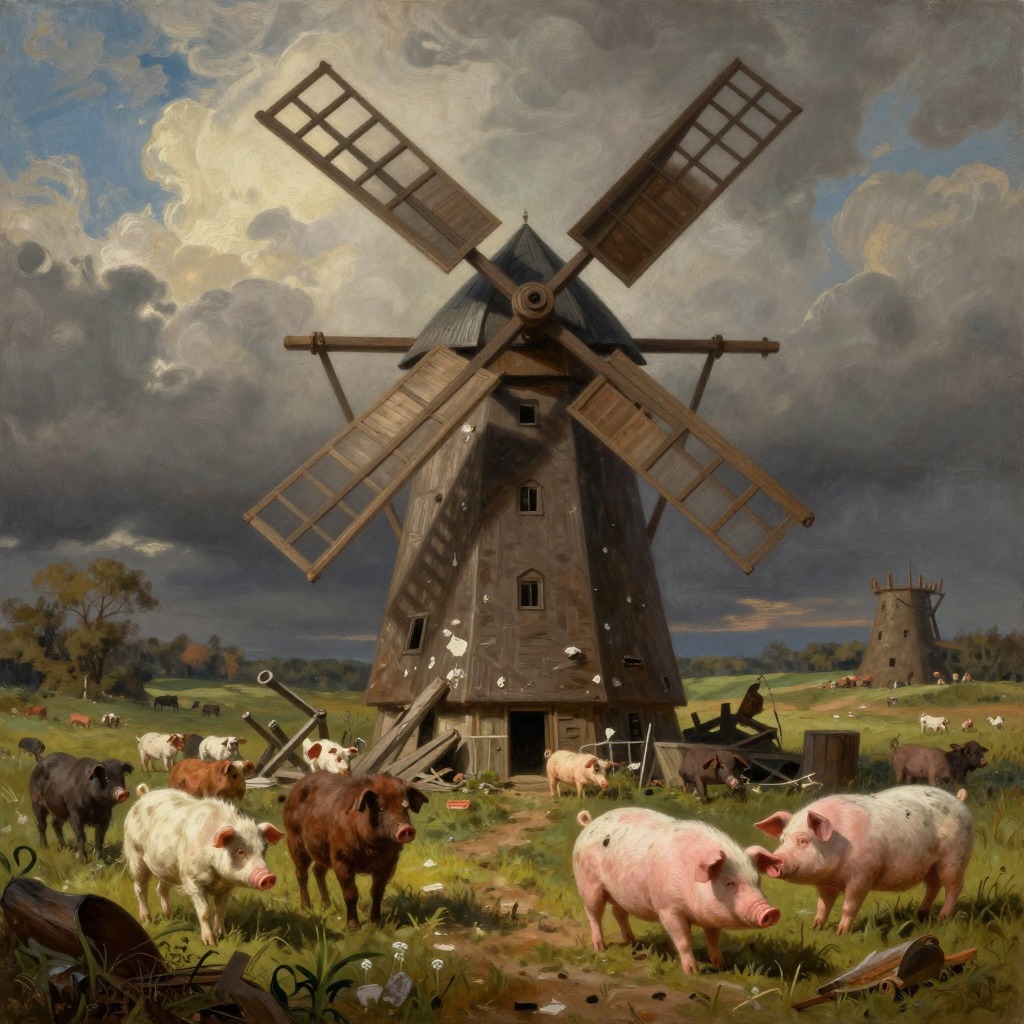
The second construction was even more punishing: the walls were made three feet thick instead of eighteen inches, the quarry was often snowbound, and the animals worked through bitter cold and hunger. Squealer's statistical reports claimed ever-increasing production, but the animals felt they labored longer and ate no better than in Jones's time. Yet the windmill rose again, and when it was finished, Napoleon came down with his retinue, congratulated the workers, and named it Napoleon Mill. The triumph was short-lived. Mr. Frederick of Pinchfield, who had already cheated the farm with forged banknotes, led an armed attack on the farm. His men drilled a hole in the base of the windmill, packed it with blasting powder, and detonated it. The explosion reduced the mill to rubble, flinging stones hundreds of yards. The animals rallied in fury and drove Frederick's men out, but the windmill was gone for the second time.
Years passed, and the windmill was finally completed a third time. It was never used to generate electricity; instead it milled corn and brought in a handsome money profit. The farm grew richer, but the animals themselves remained on short rations, while the pigs and dogs prospered. The windmill became a showpiece: when neighboring farmers were invited on a tour of inspection, they admired it above all else. The luxuries Snowball had once promised—electric light, hot and cold water, a three-day week—were no longer mentioned. Napoleon had denounced such ideas as contrary to the spirit of Animalism. The windmill's trajectory mirrored the Revolution itself: a dream of liberation through technology, corrupted by power struggles, exploited by a new elite, and finally reduced to a mere instrument of profit.